Product discovery masterclass
Discovery That Works
Ask sharper questions, uncover the real need behind unclear requests and avoid investing in the wrong product solution.
Read full Discovery That Works details
This masterclass uses structured, energising exercises to help Product and Engineering uncover real needs behind unclear requests.
Participants learn to move from “We need feature X” to “The real problem is Y”, validate assumptions and use lightweight discovery shortcuts when stakeholders are busy and time is limited.
You’ll learn
- How to ask sharper questions and identify the business problem behind a feature request
- How to test assumptions before committing to a solution
- How to run lightweight discovery within real-world enterprise constraints
Practical activity: In The 5 Whys Race, teams work backwards from vague requests through red herrings, contradictions and hidden constraints to uncover the real problem.
Engineering Masterclass
Engineering Trade-offs
Bring technical possibilities and consequences into product shaping before scope and solution are fixed.
Read Engineering Trade-offs details
Teams compare a quick bespoke implementation, a reuse option and a more durable design against the same product outcome.
You’ll learn
- How to explain architecture and integration implications clearly
- How to surface security, maintainability, cost and time-to-value
- How to keep multiple viable options open long enough to make a better decision
Take away: two or three viable technical options with their consequences made visible.
Platform product workout
Capability Thinking
Turn platform constraints into product opportunities by aligning business outcomes with capability-based technology teams.
Read full Capability Thinking details
This short, highly interactive game-based module brings platform, capability, Product and Engineering teams together around shared outcomes.
Participants break down capability-alignment myths, map business goals to platform capabilities and avoid creating shadow products that bypass the organisation’s operating model.
You’ll learn
- How to communicate product needs effectively to capability teams
- How to expose bottlenecks, alignment gaps and hidden dependencies
- How to shape roadmaps that work for both technology and the business
Practical activity: In Capability Map Sprint, attendees map business outcomes to capability teams in real time, then redesign the flow to improve delivery.
Team Workout
Estimate
Use relative sizing and historical delivery performance to forecast what the team can deliver and when, with assumptions and uncertainty made visible.
Read full Estimate details
Product and Engineering size options relative to familiar work, then use the team’s historical throughput and cycle times to forecast capacity and delivery. Teams make assumptions explicit and adjust forecasts as availability, dependencies and the mix of work change.
You’ll learn
- How to size work relatively using shared reference examples
- How to use historical performance to forecast capacity and delivery ranges
- How to account for uncertainty and refine forecasts with actual results
Take away: relatively sized options and a delivery forecast grounded in the team’s history, with clear assumptions and uncertainty.
Leadership drivethrough
Decide
Make a clear Product and Engineering decision after the options, trade-offs and estimate are understood.
Read full Decide details
Teams frame the choice, use the evidence available and record what was chosen, why and what could cause them to revisit it.
You’ll learn
- How to compare options against the intended outcome
- How to balance value, effort, risk and uncertainty
- How to name the decision owner and conditions for revisiting the choice
Take away: an explicit decision, its rationale, owner and review point.
Product delivery workout
Delivery Engine
Keep product delivery moving by prioritising effectively, managing dependencies and shaping releases that deliver value early.
Read full Delivery Engine details
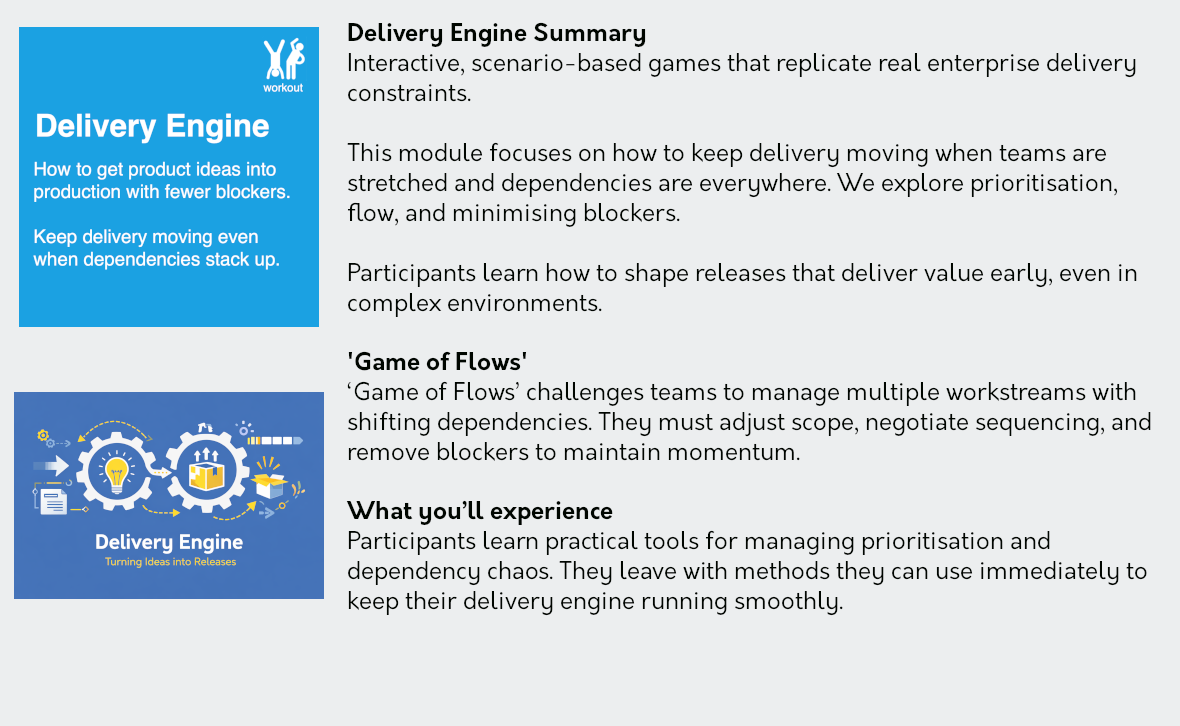
Interactive, scenario-based games replicate real enterprise delivery constraints. The module explores prioritisation, flow and minimising blockers when teams are stretched and dependencies are everywhere.
Participants learn how to shape releases that deliver value early, even in complex environments.
You’ll learn
- How to manage prioritisation across competing workstreams
- How to adjust scope and negotiate sequencing as dependencies shift
- How to identify and remove blockers while maintaining momentum
Practical activity: Game of Flows challenges teams to manage multiple workstreams and dependency changes using practical techniques they can apply immediately.
Quality popup
Quality
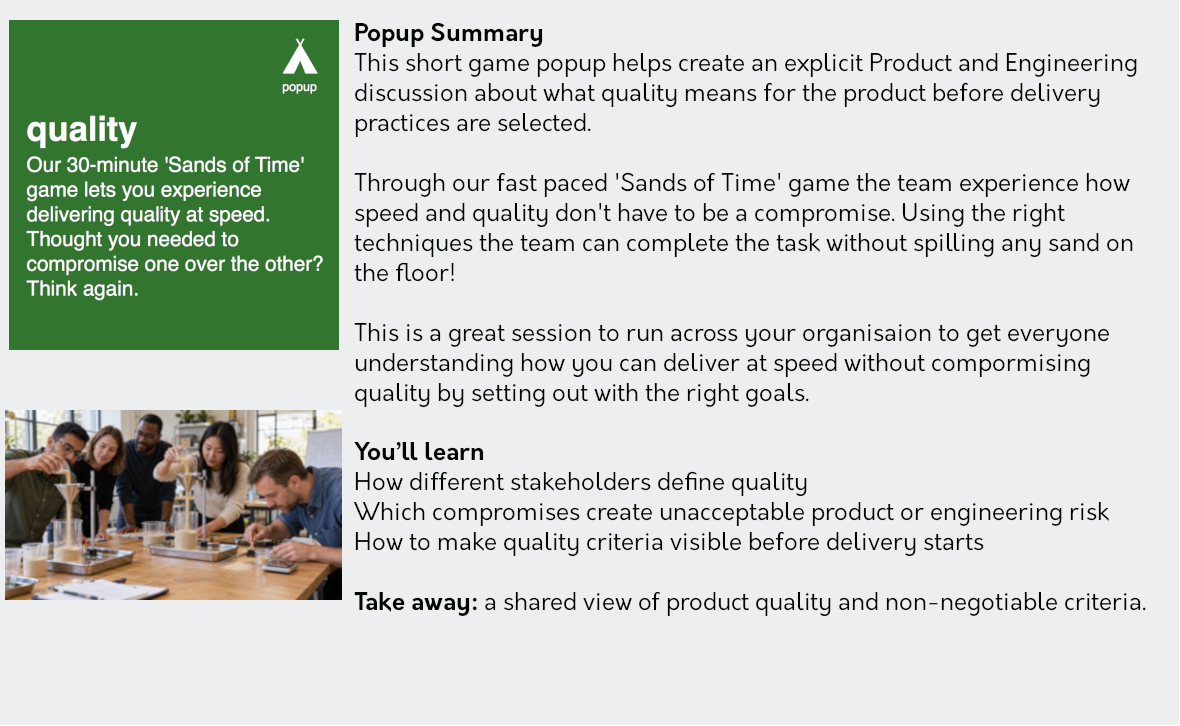
Experience the pressure of delivering quality at speed and agree which compromises are unacceptable.
Read full Quality details
This short opener creates an explicit Product and Engineering discussion about what quality means for the product before delivery practices are selected.
You’ll learn
- How different stakeholders define quality
- Which compromises create unacceptable product or engineering risk
- How to make quality criteria visible before delivery starts
Take away: a shared view of product quality and non-negotiable criteria.
Product metrics masterclass
Data-Driven Decisions
Define a small set of customer, business and product measures that show whether the chosen option achieved its intended outcome.
Read full Data-Driven Decisions details
Hands-on activities help teams choose meaningful outcome measures and use evidence to make the next product decision.
You’ll learn
- How to define measures linked to the original outcome
- How to distinguish useful evidence from dashboard noise
- How to turn results into a clear next decision
Take away: a focused measure set and the next question the team will answer.
AI prototyping masterclass
Prompt Prototyping
Quickly create AI-driven product prototypes so ideas can be tested before committing engineering capacity.
Read full Prompt Prototyping details
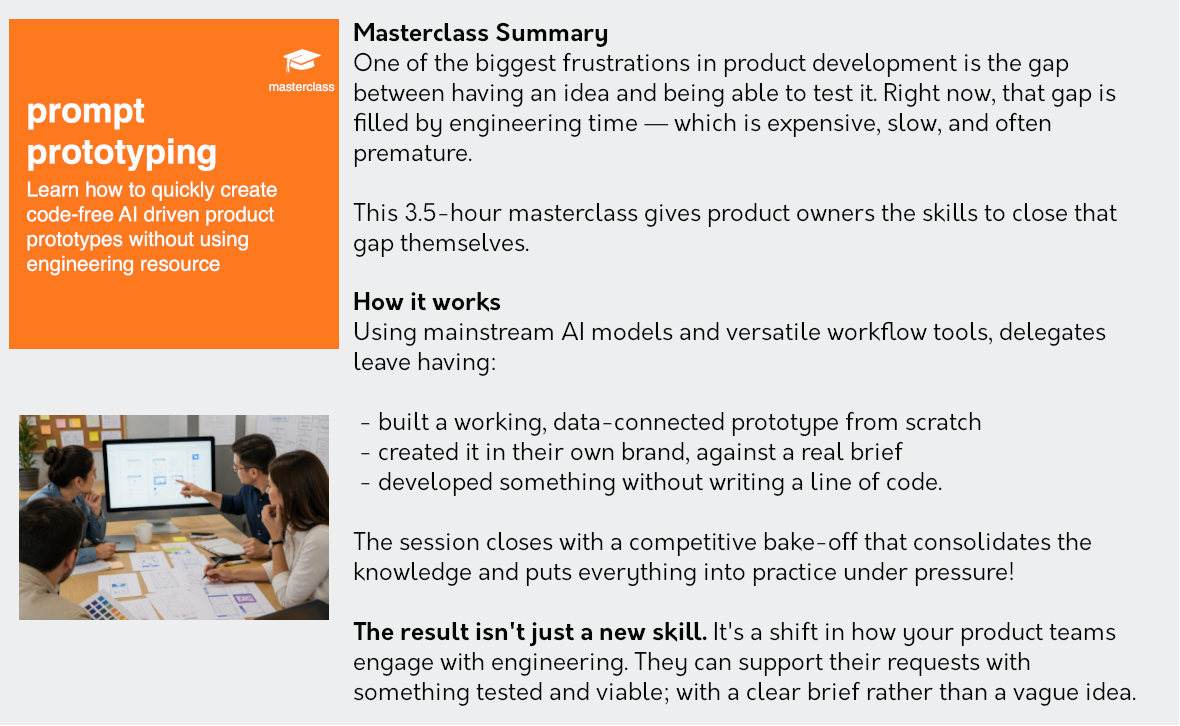
One of product development’s biggest frustrations is the gap between having an idea and being able to test it. This 3.5-hour masterclass helps teams close that gap.
Using mainstream AI models and versatile workflow tools, participants build a working, data-connected prototype from scratch, apply their own brand and respond to a real brief—all without writing code.
You’ll learn
- How to turn a product brief into a testable AI-assisted prototype
- How to connect data and apply brand requirements before committing engineering resource
- How to present a tested concept and clearer brief to engineering teams
Positive outcome: A competitive bake-off consolidates the learning and puts new prototyping skills into practice under pressure.
AI workout
AI Experimenter
Use structured experiments to reduce uncertainty, test AI-enabled product ideas and learn from failure.
Read full AI Experimenter details
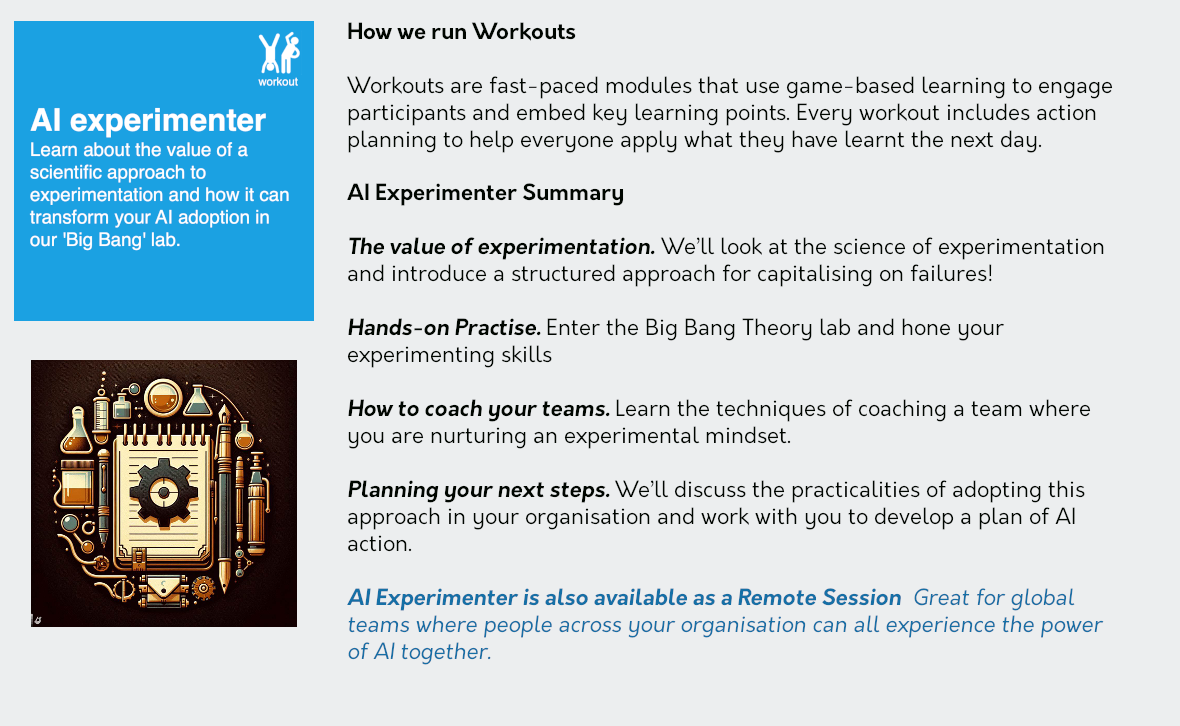
This module explores the science of experimentation and introduces a structured approach that helps teams capitalise on both successful and unsuccessful tests.
You’ll learn
- How structured experimentation can reduce uncertainty and reveal useful evidence
- How to choose measures that show whether an AI-enabled idea is working
- How to plan practical next steps and develop an AI action plan
Practical activity: Enter the Big Bang lab to practise experimentation skills and turn the results into a clear next decision.
AI workout
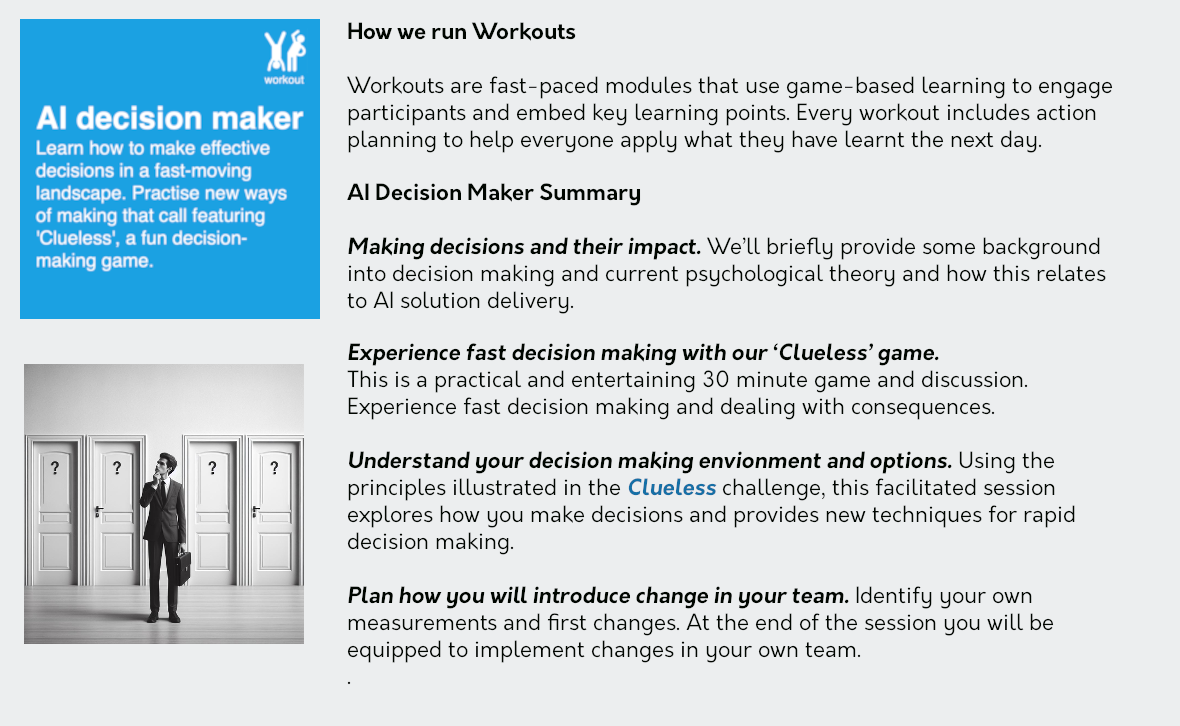
AI Decision Maker
Practise making responsible decisions about AI solutions in a fast-moving environment where evidence and time are limited.
Read full AI Decision Maker details
The module introduces decision-making principles and relevant psychological theory, then connects them to the choices Product and Engineering make when delivering AI solutions.
You’ll learn
- How decisions and their consequences affect people, products and delivery
- Techniques for making rapid decisions when information or time is limited
- How to retain an accountable human decision owner when AI informs the evidence
Practical activity: Clueless is a 30-minute game and discussion that exposes teams to fast decisions and their consequences.
AI masterclass
AI-Assisted Engineering
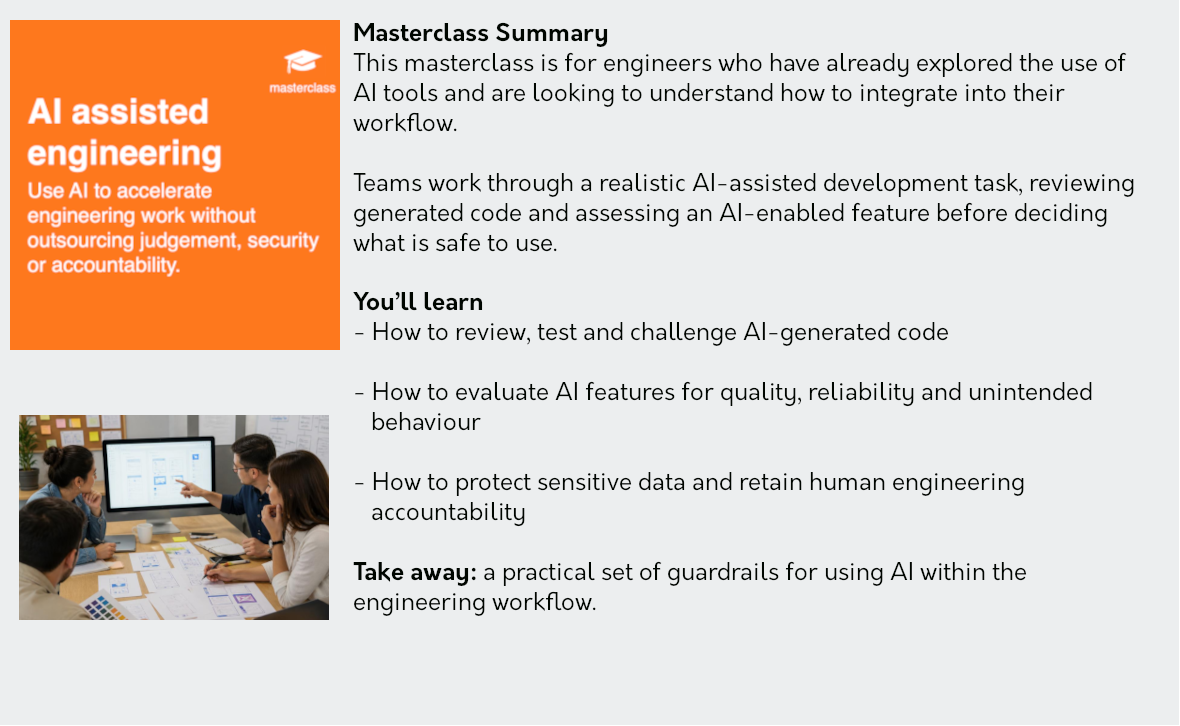
Use AI to accelerate engineering work without outsourcing judgement, security or accountability.
Read proposed AI-Assisted Engineering details
Teams work through a realistic AI-assisted development task, reviewing generated code and assessing an AI-enabled feature before deciding what is safe to use.
You’ll learn
- How to review, test and challenge AI-generated code
- How to evaluate AI features for quality, reliability and unintended behaviour
- How to protect sensitive data and retain human engineering accountability
Take away: a practical set of guardrails for using AI within the engineering workflow.